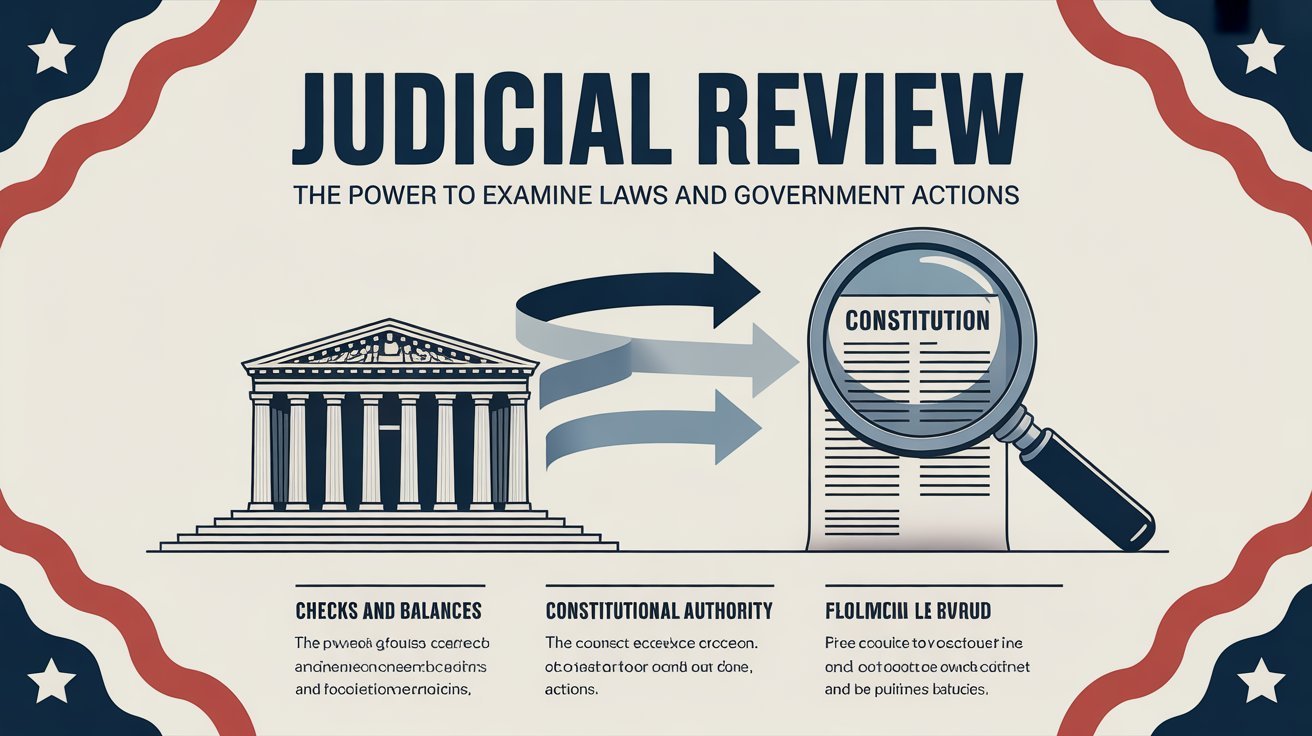
What is Judicial Review?
Judicial review stands as a cornerstone of modern democratic systems, allowing courts to examine and potentially invalidate actions taken by other branches of government. At its core, it ensures that no one—not even lawmakers or executives—operates above the law. This process helps maintain a balance of power, protects individual rights, and upholds constitutional principles. But what exactly does it entail, and why does it matter so much in today’s world? In this article, we’ll explore the ins and outs of judicial review, from its origins to its global applications, while highlighting its strengths and challenges.
Understanding Judicial Review: A Basic Definition
Judicial review refers to the power of courts to assess whether laws, executive decisions, or administrative actions align with a country’s constitution or higher legal standards. If something is found to violate these rules, the court can declare it invalid or “strike it down.” This isn’t about judging if a decision is wise or popular—it’s strictly about legality and constitutionality.
|
|
Guest Profile
|
The Necessity and Concept of Judicial Review
Judicial review is a vital legal process where a court of law examines the actions of the executive, legislative, and administrative arms of the government. The primary goal is to determine whether such actions are consistent with the established constitution and legal statutes. In a democratic society, this process acts as a safeguard against the arbitrary use of power.
Why Do We Need Judicial Review?
The need for judicial review arises from the principle of the “Rule of Law.” Without a mechanism to check government decisions, there is a risk of constitutional violations and infringement on individual liberties. It ensures that no branch of government exceeds the authority granted to it by the people through the constitution.
Key Purposes of Judicial Review
- Protecting Fundamental Rights: It provides a remedy for citizens whose constitutional rights have been violated by state action.
- Maintaining Constitutional Supremacy: It affirms that the constitution is the supreme law and any act contrary to it is void.
- Preventing Abuse of Discretion: Administrative bodies are held accountable for their procedures and decisions, ensuring they act within the bounds of logic and fairness.
- Interpreting the Law: The judiciary clarifies the meaning of statutes when there is ambiguity in legislation.
Conclusion
Ultimately, judicial review is not about the judiciary being superior to other branches, but about the law being superior to all. It maintains the balance of power and ensures that the government remains a servant of the law, rather than its master.
In simpler terms, imagine the government as a team playing a game. The judiciary acts as the referee, ensuring everyone follows the rules outlined in the constitution. Without this oversight, one branch could dominate, leading to potential abuses of power. Judicial review isn’t explicitly mentioned in many constitutions, including the U.S. one, but it’s implied through the structure of government and the need for checks and balances.
This power varies by country. In some places, like the United States, any court can exercise it, while others have specialized constitutional courts dedicated to this task. The key is that it provides a mechanism for ordinary people to challenge government overreach, making it a vital tool for justice.
The Historical Roots of Judicial Review
The concept of judicial review didn’t appear out of nowhere—it evolved over centuries. Early traces can be seen in medieval Europe, where thinkers like Montesquieu championed the separation of powers to prevent tyranny. However, it truly took shape in the United States during the early 19th century.
The landmark case that cemented judicial review in the U.S. was Marbury v. Madison in 1803. Chief Justice John Marshall argued that the judiciary must have the authority to interpret the Constitution and invalidate conflicting laws. This decision arose from a political dispute: William Marbury sued to force the delivery of his judicial commission, but the Court ruled that part of the law giving it jurisdiction was unconstitutional. Marshall’s opinion established that “it is emphatically the province and duty of the judicial department to say what the law is.”
Before this, colonial courts in America had occasionally invalidated local laws, and the British Privy Council reviewed colonial legislation. Post-Revolutionary state courts also struck down statutes conflicting with state constitutions. Globally, the idea spread after World War II, as nations sought to prevent the rise of dictatorships by embedding strong judicial checks. Hans Kelsen, an Austrian jurist, influenced many European systems by advocating for dedicated constitutional courts.
Today, judicial review is a hallmark of constitutional democracies, but its history shows it’s not without controversy—early critics like Thomas Jefferson saw it as undemocratic, giving unelected judges too much sway.
Judicial Review in the United States
In the U.S., judicial review is decentralized, meaning any federal or state court can declare a law unconstitutional, though the Supreme Court has the final say. This power stems from Article III of the Constitution, which vests judicial authority in the courts, implying the need to resolve conflicts between laws and the Constitution.
The process typically starts when someone affected by a law or action files a lawsuit claiming it’s unconstitutional. Courts review it under standards like “strict scrutiny” for fundamental rights or “rational basis” for economic regulations. If invalid, the decision can apply broadly, affecting similar cases nationwide.
Notable early uses include Hylton v. United States (1796), where the Court upheld a carriage tax, showing restraint. But Dred Scott v. Sandford (1857) infamously misused judicial review to invalidate the Missouri Compromise, exacerbating tensions leading to the Civil War. Modern applications continue to shape society, from civil rights to economic policy.
Key Examples of Judicial Review in the U.S.
Judicial review has produced some of America’s most transformative decisions. Take Brown v. Board of Education (1954), where the Supreme Court struck down school segregation laws as violating the Equal Protection Clause of the 14th Amendment. This ended “separate but equal” doctrine, advancing civil rights.
Another pivotal case is Roe v. Wade (1973), which invalidated state abortion bans under a right to privacy implied in the Constitution. Though later overturned in Dobbs v. Jackson Women’s Health Organization (2022), it highlighted how judicial review can protect personal liberties.
In Citizens United v. FEC (2010), the Court used judicial review to strike down campaign finance limits, equating corporate spending with free speech. This decision drew widespread criticism for amplifying money in politics. More recently, cases like Obergefell v. Hodges (2015) legalized same-sex marriage nationwide by invalidating state bans.
These examples show judicial review’s dual edge: it can drive progress but also spark backlash if seen as overreaching.
Judicial Review Around the World
While the U.S. model is influential, judicial review looks different globally. In Europe, many countries use a centralized system with dedicated constitutional courts. Germany’s Federal Constitutional Court, established post-World War II, reviews laws for compatibility with the Basic Law and has struck down measures on privacy and equality.
France’s Constitutional Council reviews laws before they take effect, focusing on abstract constitutionality rather than specific cases. In contrast, the United Kingdom traditionally emphasized parliamentary sovereignty, limiting judicial review to administrative actions, not primary legislation. However, the Human Rights Act 1998 allows courts to declare laws incompatible with European human rights standards, prompting parliamentary response.
India’s Supreme Court wields broad judicial review powers, often expanding rights through public interest litigation. Countries like Canada and South Africa blend elements, with courts reviewing laws under charters of rights. Over 100 nations now incorporate some form of judicial review, reflecting its role in safeguarding democracy after authoritarian eras.
The Importance of Judicial Review
Judicial review is essential for several reasons. First, it upholds the rule of law by ensuring government actions respect constitutional limits, preventing arbitrary power. It protects minority rights when majorities might overlook them—think desegregation or free speech for unpopular groups.
Second, it maintains separation of powers, acting as a check on legislative and executive branches. Without it, laws could erode freedoms unchecked. Third, it fosters stability by resolving disputes peacefully through legal channels, building public trust in institutions.
In practice, it encourages careful lawmaking, knowing courts might scrutinize decisions. Globally, it’s credited with preventing totalitarian slides by empowering judges to curb excesses. Ultimately, judicial review ensures constitutions aren’t just words on paper but living documents guiding fair governance.
Criticisms and Challenges of Judicial Review
Despite its benefits, judicial review faces sharp criticism. Detractors argue it’s undemocratic, allowing unelected judges to override elected officials’ decisions. Thomas Jefferson called it a “despotism of an oligarchy,” fearing judicial overreach.
Progressives like Theodore Roosevelt criticized “Lochner-era” rulings that struck down labor laws, favoring business interests. Today, conservatives decry “activist judges” in cases like abortion or gun rights. Some say it politicizes the judiciary, with appointments becoming partisan battles.
Another issue is “jurisdiction stripping,” where legislatures limit court review, potentially undermining checks and balances. Critics also point to inconsistent application—courts sometimes defer too much or intervene excessively. In polarized times, decisions can erode public confidence if seen as biased.
Yet, proponents counter that without judicial review, vulnerable groups would lack protection, and constitutions would lose teeth.
Conclusion
Judicial review remains a powerful, if contentious, force in governance. From its humble beginnings in early American courts to its global spread, it has shaped societies by enforcing constitutional boundaries and safeguarding rights. While it empowers the judiciary to check abuses, it also invites debates about democracy and balance. In an era of rapid change, its role in protecting freedoms while respecting elected branches is more crucial than ever. By understanding judicial review, we appreciate how it keeps power in check, ensuring justice for all. As systems evolve, refining this tool—perhaps through clearer guidelines or diverse judicial appointments—could address criticisms and strengthen its legacy.
FAQs
What is the main purpose of judicial review?
The primary goal is to ensure that government actions comply with the constitution, protecting rights and maintaining checks and balances.
Who established judicial review in the U.S.?
Chief Justice John Marshall in the 1803 case Marbury v. Madison formalized this power for American courts.
Can judicial review be overturned?
Court decisions can be reversed by later rulings, constitutional amendments, or legislative changes, but it’s a high bar.
How does judicial review differ internationally?
In the U.S., it’s decentralized across courts; in Europe, specialized tribunals often handle it, focusing on abstract reviews.
Is judicial review always beneficial?
It protects minorities and upholds law but can be criticized for overriding democratic will or enabling judicial activism.














Post Comment